


2025 Safety in Spine Surgery Summit Celebrates 10 Years
When Michael G. Vitale, MD, MPH, chief of pediatric spine surgery at NewYork-Presbyterian Morgan Stanley Children’s Hospital of Children’s Hospital of New York and Och Spine at NewYork-Presbyterian, started the Safety in Spine Surgery Summit, his vision was clear: bring together leading experts in adult and pediatric spine surgery to create best practices that reduce complications and enhance patient outcomes.
The impetus for its creation centered around his own experiences trying to reduce surgical site infections. That was over a decade ago, and this May, the Safety in Spine Surgery Summit marked its 10th annual meeting, where much of the conversation focused on what has been accomplished since the organization’s launch and areas of focus for the future.
“When I started this, I wanted to raise awareness around fundamental safety science, emphasizing systems-based thinking, reducing variability through collaboration, and fostering a culture that improves the surgical environment,” says Dr. Vitale. “Some of the ways you do that is by doing research; disseminating that research; keeping an active, rich website with resources; and running meetings like this. So, it’s been a thrill to be a part of this journey that we’re all on together.”
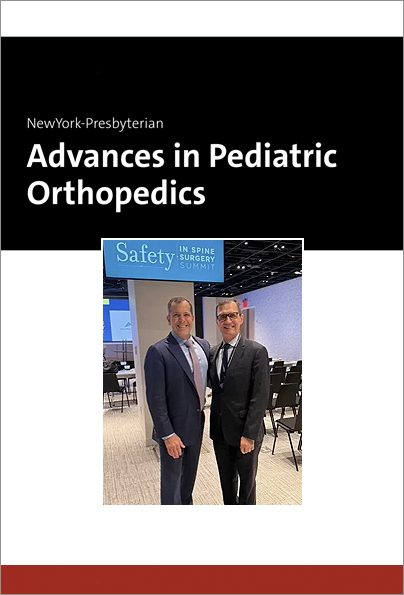
Dr. Vitale (left) and Dr. Lawrence Lenke served as chair and co-chair, respectively, of the 10th annual Safety in Spine Surgery Summit.
The Inception of Safety in Spine Surgery
Dr. Vitale’s realization that the field needed better surgical safety protocols began in 2008 when, soon after becoming chief, a spike in infections prompted him to temporarily suspend pediatric spine surgeries. “The infection rate was not acceptable, which led us to conduct an in-depth, interdisciplinary review of infection-prevention protocol at our institution to determine the root causes and implement targeted interventions,” he says. Following the review, several new protocols were put in place, including:
- An antibiotic prophylaxis education program
- Room traffic reduction program
- Addition of tobramycin to prophylaxis regimen
- High volume lavage
- Pre-operative chlorhexidine gluconate showers
Tackling a Range of Spinal Surgery Risks
Each meeting since has focused on a different aspect of preventing harm in spine surgery, generating peer-reviewed consensus guidelines and checklists on topics such as:
- Adolescent idiopathic scoliosis bracing
- Use of halo gravity traction for pediatric spinal deformity
- Prevention of wrong level surgery in spinal deformity
- Surgical site infection (SSI) prevention with surgical treatment of early-onset scoliosis
- Response to intraoperative neuromonitoring (IONM) changes in patients with a stable spine
- Response to IONM events in high-risk spinal deformity surgery
- Recommendations to prevent, diagnose, and treat SSI in high-risk pediatric spine surgery
- Recommendations for avoiding errors in robotic-assisted spine surgery (RASS)
“In just one day, attendees walk away with actionable strategies to improve surgical safety for their patients,” says Dr. Vitale. “A lot of the people coming to our meetings are not necessarily part of a big university-based system. They are starting to adopt these same practices, have multidisciplinary preoperative conferences, and are doing formal risk stratification, which are part of a systems approach that, in the past, was unusual.”
“This forum allows us to work across disciplines, institutions, and countries to tackle the most urgent challenges in spine surgery.” — Dr. Michael Vitale
Topics Covered at the 2025 Spine Summit
Topics covered at the 2025 summit included intraoperative neuromonitoring technologies for pediatric and adult spine procedures, enabling technologies, safety in surgical education, and surgeon well-being, among others. NewYork-Presbyterian physicians presenting at the conference included:
- Lawrence Lenke, MD, co-director of Och Spine at NewYork-Presbyterian and Columbia and co-chair of the Safety in Spine Surgery Summit, who discussed new research in spinal deformity intraoperative monitoring and machine-learning risk factors for spinal-cord related and lumbar nerve root-related IONM data loss.
- Joseph Lombardi, MD, orthopedic spine surgeon at Och Spine at NewYork-Presbyterian and Columbia and a program chair for the summit, who gave an update on robotic spine surgery safety guidelines and best practices.
- Ronald Lehman, Jr., MD, division chief of spine surgery at Och-Spine at NewYork-Presbyterian and Columbia, who discussed advancements on the horizon for robotic spine surgeries, including the impact of AI to help with pre-operative planning; the evolution of how robotic arms could be used; and advancements in software to help with screw placement.
- Taemin Oh, MD, director of pediatric neurosurgical scoliosis surgery at NewYork-Presbyterian Morgan Stanley Children’s Hospital of Children’s Hospital of New York and Och Spine at NewYork-Presbyterian, who discussed his best practices for vertebral body tethering.
The keynote speaker was Rex Marco, MD, a spine surgeon and musculoskeletal oncologist at UTHealth Houston McGovern Medical School who became paralyzed six years ago after a cycling accident. Despite sustaining a C4-level spinal cord injury, Dr. Marco continues to teach and mentor residents. “He’s really an inspiration and his talk served as a reminder of the unpredictability of life and the resilience required to move forward,” says Dr. Vitale.
All the presentations are available on the Safety in Spine Surgery Project website.
“This forum allows us to work across disciplines, institutions, and countries to tackle the most urgent challenges in spine surgery,” he says. “There’s still enormous opportunity to improve care. Together, we’re developing the tools to get there.” — Dr. Michael Vitale
The Path Forward
As S3P and the summit enters its second decade, Dr. Vitale remains committed to collaborative progress. Future agendas will be selected based on the latest advancements in the field, but he foresees enabling technologies like robotics and enhanced navigation remaining hot topics. “This forum allows us to work across disciplines, institutions, and countries to tackle the most urgent challenges in spine surgery,” he says. “There’s still enormous opportunity to improve care. Together, we’re developing the tools to get there.”