So here we go again. This wasn’t my first time dealing with a sports-related injury. Seven years ago, Dr. Ahmad repaired my distal biceps, torn when we were skiing together with our kids. Since then, I’ve had various musculoskeletal issues related to my active lifestyle and profession as a pediatric spine surgeon. But this time, it felt different. Years of complex spine surgeries, where surgeons must put our limbs in unnatural, high-load positions, finally caught up to me. And, my passion for paddle tennis had pushed my shoulder to its limit. The injections were no longer providing relief, and it was time to meet with Dr. Chris Ahmad to review the MRI results.
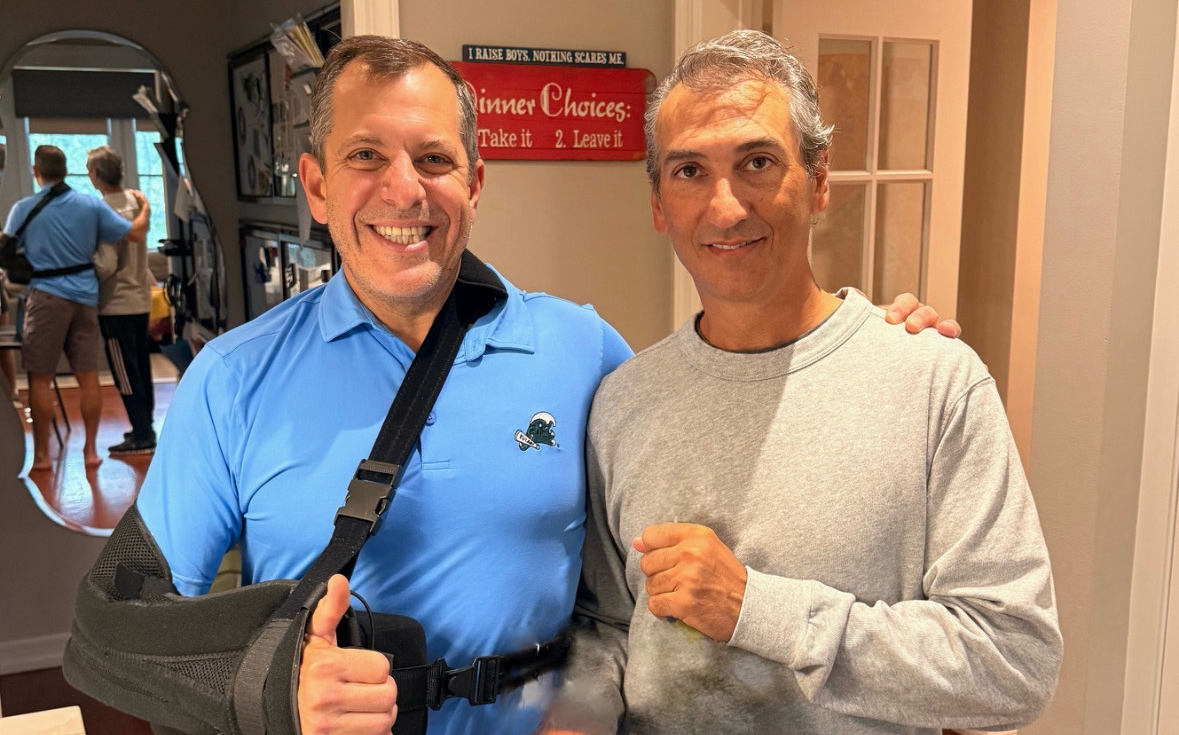 Drs. Vitale (left) and Ahmad (right), post-surgery.
I already knew the news from reviewing the MRI myself and reading the report. I have a more technical understanding than most, so I could see the implications of my massive rotator cuff tear: the inevitable pain and suffering of surgery and recovery, and most importantly, the potential impact on both my career and my lifestyle. There was never any question about who I would trust to explain the situation to me.
Many people facing a difficult medical reality would go online to read reviews, compare websites, and ask friends for opinions that might not be based on facts or statistics. But I understood that this was about performance. I needed a surgeon who was a true zealot for their craft. Someone who had spent their waking hours mastering the art of human anatomy, who had developed and refined surgical procedures, and who was trusted by some of the most valuable shoulders in the world.
Dr. Ahmad was sober and honest about my tear. This wasn’t a simple, high-five-in-the-hallway procedure with a guaranteed quick return to work and sport. Yet, on the day of the surgery, I felt utterly calm. I had done the pre-hab, rehearsed what it would be like to live strictly in a sling, and, most importantly, I had complete certainty that I had controlled the most critical variable: the choice of surgeon.
We were both hoping the MRI had overstated the pathology, but unfortunately, that wasn’t the case. As I woke from sedation, I saw my friend and surgeon, Chris Ahmad. He told me that everything had gone great, but that the tear was worse than he had initially thought. He recounted his thought process during the surgery:
Slowly, he mobilized the tear through a series of complex releases and was able to re-dock the tendon where it belonged. As he instructed his fellow to close the arthroscopic portals, there was a massive sense of relief and a feeling of exhaustion that so often follows a high-stakes performance.
THE UNIVERSAL NATURE OF PERFORMANCE
Performance is a universal concept, although the stakes are different in surgery, athletics, business, and other fields. At the end of the day, people are depending on you not just to do your job but to perform with a level of mastery that allows your “customers” to be the best they can be. The athlete needs to get back in the game, the board member has a responsibility to the business, and the surgeon has a sacred obligation to their patient. I hope that you find value in the words shared in this blog—value you can take back to those around you who depend on your extraordinary level of performance.