The question I hear most often at the Children’s Hospital is, “What happened?” While rotator cuff tears are typical for my age, they are nearly 15 times more frequent in spine surgeons, and I am no exception. Despite my work in developing more ergonomic surgical tools and techniques, it’s clear we operate under significant physical stress. My colleague, Dr. David Skaggs, has shown that the loads placed on our joints during surgery can be up to 15 times higher than what’s considered safe by OSHA standards. It’s a risk many of us face, with several friends and partners at Columbia having had shoulder surgery or suffering from other work-related injuries. While these “wear-and-tear” issues may not be entirely avoidable, I am using this time to collaborate with Highridge Medical to create instruments that prioritize the surgeon’s well-being. The picture below shows me performing a simulated surgery using tools I developed with the brilliant engineers at Highridge Spine, which help us maintain more ergonomic, safer positions. If a forced break like this is the cost of my work, it’s a price I’m willing to pay for the tremendous privilege of helping children with complex spine problems, and helping other surgeons avoid overuse injuries.
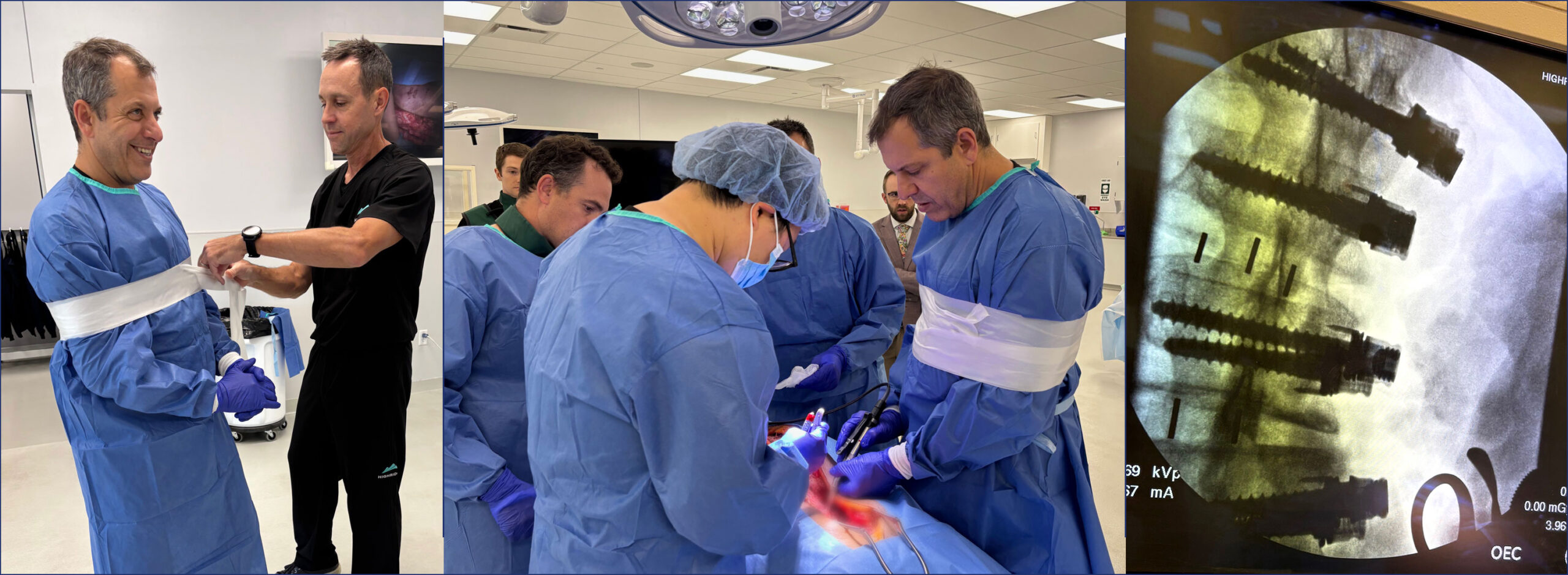
Here friends at Highridge Spine tape my arms to my side to allow me to trial newly developed instruments and techniques that avoid common shoulder injuries. We successfully used these new “surgeon preservation” tools to perform a vertebral body tether with apical fusion in a cadaver.
But the physical challenges pale in comparison to the mental and emotional toll of our work. The privilege of caring for high-risk patients from all over the world comes with immense stress. Even with decades of work dedicated to making spine surgery safer, we are inevitably humbled by reality. Last year, our team had the lowest infection rate in a national registry of 60 hospitals, with zero infections in over 300 complex pediatric spine surgeries. But this summer, we had two. The rare but devastating risk of permanent neurological injury is even more challenging to face. While I am incredibly proud of my team and our results—until this summer, I had never had a significant neurological problem in one of my patients—a recent case reminded me of our vulnerability. Luckily, she made a complete recovery but operating on the highest risk patients in the world takes a toll.
One of my International patients developed a very rare postoperative neurological issue, one with only 14 reported cases in the world literature. It felt incredibly unfair. Navigating this journey with her family has been difficult, but seeing her regain a massive amount of function has been highly gratifying. We celebrated when she was discharged, when she walked in Central Park, and when she landed safely back in Ireland. The decision to perform a second surgery on her was terrifying, but it was necessary. All went well.
One day, during my regular visits with this kid’s family, I saw a poster that was put up in the hallway of our hospital called “The Courage to Care,” written by Cindy Bertullucci.
As I recover from my own shoulder surgery on my 11th post-op day, I think about my friend and surgeon, Dr. Christopher Ahmad. It’s not easy operating on friends and family; the stress is amplified. It requires not only caring, but courage.
Earlier this week, just before my first physical therapy session at 7:00 a.m., the therapist received a call. “It’s Dr Ahmad,” he said, a bit confused. It was a small but powerful gesture showing care and reminding me again that with “great [talent] comes great responsibility.”
I remain immensely grateful to Dr. Ahmad for his courage to care.