September 16–20, 2025 | Dr. Vitale attends SRS (Scoliosis Research Society) Annual Meeting; papers and abstracts presented
Dr. Vitale participated in the following:
- Freehand Survey to Test Understanding of Transverse Plane Modifiers and the New SRS – Lenke – Aubin 3D Classification
- Paper #2: Proportion of Lumbar End Vertebra Tilt to Overall Cobb Angle Predicts Spontaneous Lumbar Correction
- Paper #28: Developing the First Pediatric Spine Frailty Index: Machine Learning Models Predict Key Complications
- Paper #73: Lumbar Tether Successfully Avoids Fusion in 85% of Patients at Two Year Follow Up – A Multicenter Study
- Paper #108: Postpone and Posterior if Possible: Comparison of Surgical Approaches for Hemivertebrectomy
- Paper #109: Is There a Role for Bracing/Casting in the Treatment of Early Onset Congenital Scoliosis?
- Paper #131: In-Brace Correction in Scoliosis: Curve Type Matters More than Demographics
- Paper #147: Modern AIS Surgery Using Patient Specific Rods Results in Radiographic Outcomes that Closely Match Predicted and “Optimal” Sagittal Parameters
- Proportion of Lumbar End Vertebra Tilt to Overall Cobb Angle Predicts Spontaneous Lumbar Correction
- Developing the First Pediatric Spine Frailty Index: Machine Learning Models Predict Key Complications
- Lumbar Tether Successfully Avoids Fusion in 85% of Patients at Two Year Follow Up—A Multicenter Study
- Postpone and Posterior if Possible: Comparison of Surgical Approaches for Hemivertebrectomy
- Is There a Role for Bracing/casting in the Treatment of Early Onset Congenital Scoliosis?
- In-Brace Correction in Scoliosis: Curve Type Matters More than Demographics
- Modern AIS Surgery Using Patient Specific Rods Results in Radiographic Outcomes that Closely Match Predicted and “optimal” Sagittal Parameters
- History of Scoliosis Bracing Does Not Impact Mental Health Outcomes Following Definitive Surgery for Adolescent Idiopathic Scoliosis
- Pediatric Spine Surgeons Report High Mental Health Burden and Limited Support for Scoliosis Patients
- Novel Unipolar Shilla Technique for Complex EOS Provides Lasting Correction and Controlled Growth
The SRS Annual Meeting Is a 4-day program including Pre-Meeting Course, Scientific Program, Half-Day Courses, Lunchtime Symposia, Case Based Discussions, Industry Workshops, and E-Point presentations.
More About the SRS Annual Meeting
60th Annual Meeting
September 16–20, 2025 | Charlotte, North Carolina, USA
The Scoliosis Research Society (SRS) Annual Meeting is a forum for the realization of the Society’s mission and goals, the improvement of patient care for those with spinal deformities. A Faculty-led Pre-Meeting Course and abstract papers will be presented on an array of topics, including adolescent idiopathic scoliosis, growing spine, kyphosis, adult deformity, minimally invasive surgery, machine learning, and mental health considerations.
Meeting Details:
- During a five-year period, held in North America three times and outside North America twice.
- Approximately 1,500 attendees.
- The latest and greatest scientific research, methods, and techniques in spinal deformity.
- 4-day program including Pre-Meeting Course, Scientific Program, Lunchtime Symposia, Industry Workshops, and E-Point presentations.
- Podium presentations are four minutes in length.
- Minimum two-year follow up required for abstract submissions. The two-year follow up rule does not apply for categories of basic science or biomechanical studies or for topics where two-year follow up is irrelevant, such as 30 day re-admission rates.
- Topics focus on current scoliosis and spinal deformity research.
The Annual Meeting is open to anyone involved in the treatment of spinal deformities including surgeons, residents and fellows, physician assistants, nurses, and other allied health professionals and researchers. The podium presentations will provide valuable information to all individuals caring for patients with spinal deformities.
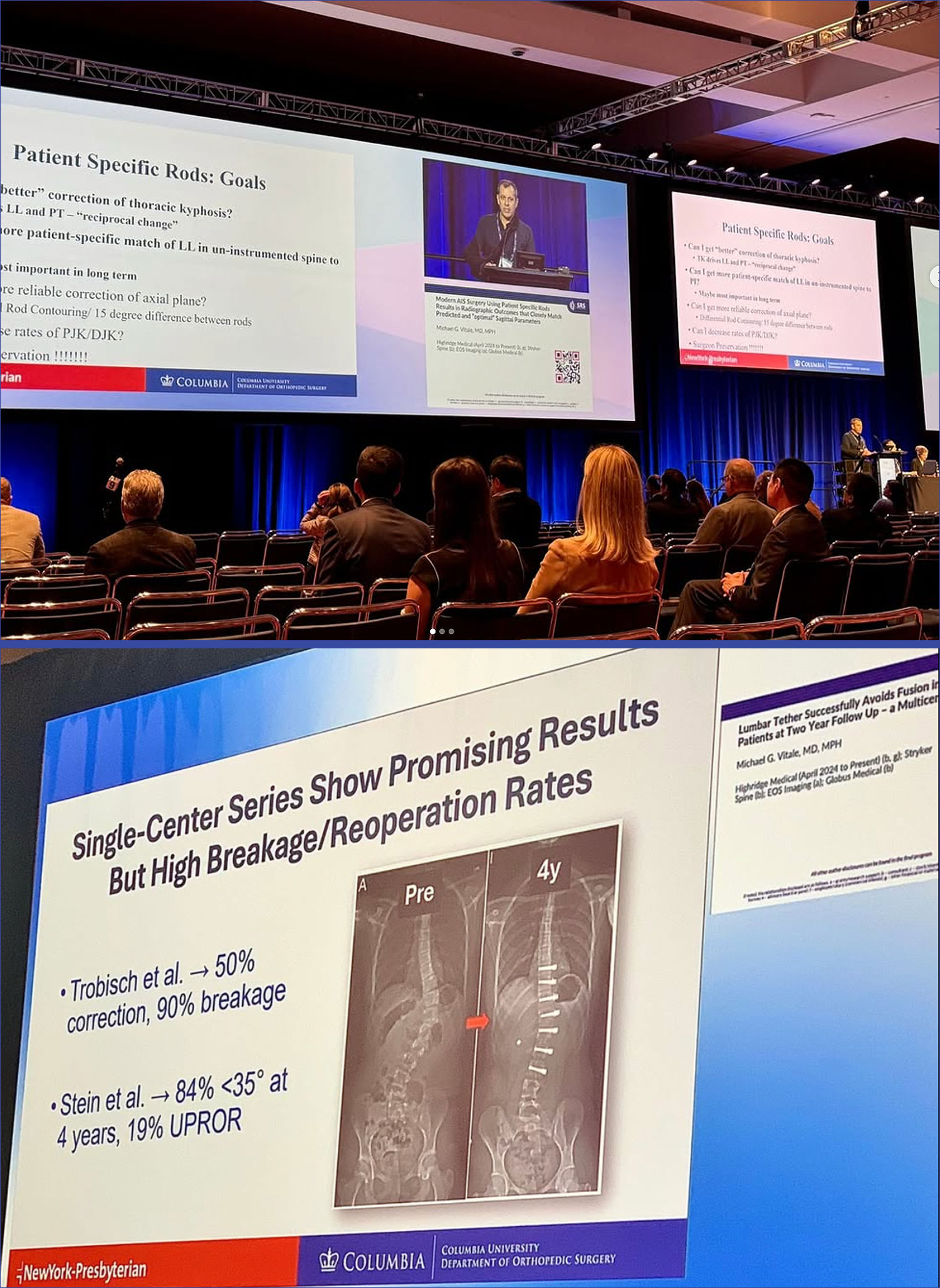
Dr. Vitale Presents at the SRS Annual Meeting
SRS President Message
The 60th SRS Annual Meeting is the realization of the Society’s vision—to provide global leadership in research and education that will result in enhanced quality of life for all patients with spinal deformities—and this year’s program was chosen from the best abstracts and proposals which supports that vision. Co-chairs Jennifer Bauer, MD, and Martin Repko, MD, along with the Annual Meeting Scientific Program Committee and Education Committee have done an outstanding job putting our program together, and I think it will be truly impactful for everyone who attends. (Read more in the final program.)
—Laurel C. Blakemore, MD, SRS President